


E-commerce development: how to build a new online store ready to grow

Professional e-commerce development, whether on a ready-made platform or as a custom online store, is a complex process that has to cover architecture, data, integrations, performance, security, SEO, the admin and future scalability. If these areas are neglected, a modern online store may look good at first but will start to hit its limits as the company grows. It slows down, becomes hard to change and connects poorly to other systems, and the sales team has to do a lot by hand.
A well-designed new online store should grow with your business. It should cope with more products, more orders, more customers, more countries and new business models. In this article, we look at what e-commerce development involves, how to choose the right technology and why it is important to think about the future from the very first design.
E-commerce development is more than design and a basket
Many companies think of e-commerce development mainly as the visual design, the product catalogue, the shopping basket and the payment gateway. These are, of course, important parts of any online store. On their own, however, they are not enough.
A modern online store has to work as a reliable system that supports sales and simplifies company processes. It has to process orders, track stock availability, show the correct prices, send data to other systems, let administrators manage content easily and let customers buy quickly without unnecessary obstacles.
Professional e-commerce development therefore deals mainly with:
- technical architecture,
- the data model,
- product structure,
- the online store admin,
- UX and the buying journey,
- performance and loading speed,
- SEO readiness,
- security,
- integrations with external systems,
- analytics and measurement,
- future extensibility of the solution.
If a new online store is designed only as a nice website with a basket, it can hit its limits very quickly, especially once the company starts to grow, expand its range, automate processes or sell abroad.
Why you need to plan for growth when designing an online store
The biggest mistake in e-commerce development is to look only at where the company is today. Today you may need to sell a few hundred products in one market. A year from now, though, you may be dealing with thousands of products, B2B customers, customer-specific prices, several warehouses, language versions or an ERP integration.
If these possibilities are not planned for from the start, every further change will be more complex and more expensive. New features get “bolted on” to a modern online store without a clear plan. The result can be a system that is hard to maintain, slow, confusing and risky to change in any major way.
An online store ready for growth has to be designed so that it can be extended step by step. It does not need every feature at launch, but its technical foundation must allow them to be added in the future.
When designing an online store, it is therefore worth thinking about these questions:
How will the company grow over the next few years?
Do we need customer-specific price lists?
Will we expand abroad?
Will we connect the online store to an ERP, warehouse or accounting system?
Do we want a mobile app or a customer portal?
How many people will work in the online store admin?
Will we also sell to B2B customers?
What data do we need to track and evaluate?
The answers to these questions affect the choice of technology, the architecture and the scope of the first version of the online store.
Choosing the technology: off-the-shelf solution or custom online store?
In e-commerce development, choosing the technology is one of the most important decisions. Not every company needs a custom solution. For smaller projects, an off-the-shelf solution or an open-source platform may be suitable. For growing companies, B2B sales and more complex processes, however, a new custom online store is often the better fit.
Off-the-shelf solutions work well mainly when you need to launch a simple online store quickly, have a standard sales process and few integrations, and do not need specific features. Their advantages are fast deployment and a lower initial investment.
The limits show, however, once you need custom logic, customer-specific trading terms, a complex admin, advanced integrations or your own processes. At that point, a ready-made solution can become a constraint.
A custom online store makes sense mainly when:
- you have non-standard business processes,
- you need integration with ERP, CRM, PIM, WMS or other systems,
- you sell to business customers,
- you need customer-specific prices and terms,
- you want your own admin tailored to your team,
- you are planning long-term growth,
- you need high performance and flexibility,
- you do not want to be limited by a ready-made platform.
The right choice of technology should not be based only on the price of the first version. You also need to look at the cost of further development, maintenance, integrations and future changes.
Online store architecture as the foundation of long-term stability
Architecture is the technical foundation of the whole online store. If it is designed well, a modern online store can be developed, changed and connected to other systems. If it is designed badly, problems start to appear with every new request.
In modern e-commerce development, it is important to separate the individual parts of the system. The frontend, the backend, the admin and the integration layer each have a different role. This separation helps manage development better, reduces the risk of errors and makes it easier to add new features.
Good online store architecture should address:
- how data is stored and processed,
- how the frontend communicates with the backend,
- how the online store connects to external systems,
- how orders are processed,
- how errors and outages are handled,
- how performance is maintained,
- how security is handled,
- how the system will be extended in the future.
For larger online stores, it is also worth considering an API-first or headless approach. This means that the new online store is designed from the start to communicate through clearly defined interfaces, so that other channels can connect to its backend in the future, such as a mobile app, a customer portal or an internal sales tool.
Data determines how well the online store will work
Data is one of the most important parts of any online store. If it is inaccurate, incomplete or poorly structured, it affects sales, the customer experience and internal efficiency.
In e-commerce development, you need to define clearly how the store will work with products, categories, attributes, prices, stock availability, customers, orders and documents. It is important to know which data is created directly in the online store and which comes from external systems.
For example, product descriptions and photos can be managed in the online store admin or in a PIM system. Stock levels can come from the warehouse system. Invoices and orders can be processed in the ERP. Marketing data can flow to analytics and advertising tools.
If the data model is not designed correctly, the result is duplicates, outdated information and manual work. The customer sees one availability in the online store and the sales rep sees another in the system. The administrator has to retype data by hand. Orders are checked manually. This holds back growth.
A well-designed modern online store has clearly defined data flows. It knows where data comes from, where it goes and which system is the main source of truth.
Integrations save time and reduce errors
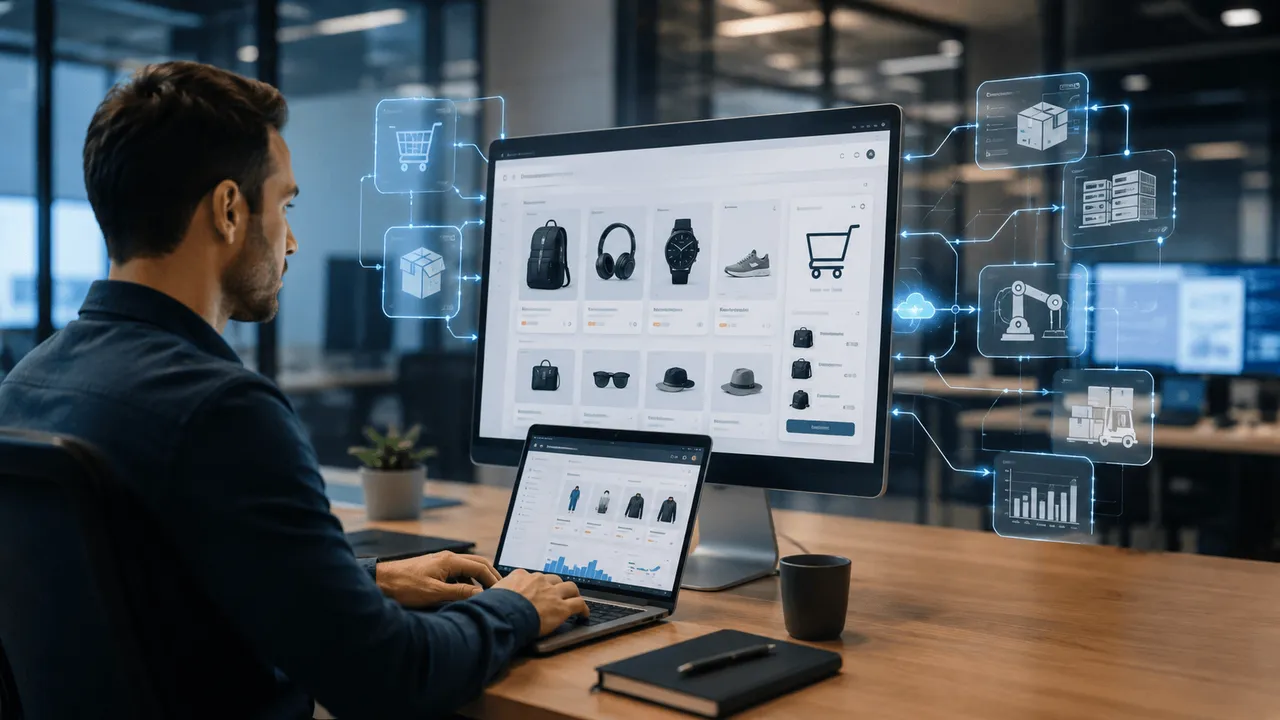
An online store should not work in isolation from the company’s other systems. The more the company grows, the more important it is to connect e-commerce with internal processes.
The most common integrations include:
- ERP systems,
- accounting systems,
- warehouse systems,
- CRM,
- PIM,
- payment gateways,
- carriers,
- invoicing tools,
- marketing and analytics tools,
- price comparison sites,
- marketplaces,
- customer support.
The aim of integrations is to reduce manual work, speed up processes and improve data accuracy. If orders are sent to the ERP automatically, stock availability is updated regularly and customers receive order status updates without manual intervention, the whole business runs more efficiently.
In e-commerce development, it is important not to treat integrations as an add-on. They should be part of the architecture design. A new online store has to be ready to connect to other systems and for those integrations to change over time.
Online store performance affects sales and SEO
The speed of an online store has a direct impact on user experience. If a page loads slowly, customers leave. With a larger range, filtering, search or high traffic, performance can be decisive.
Performance is not just a matter of optimising images or caching. It starts with the architecture, the database design, the way products and filters are handled and how a modern online store communicates with external systems.
In e-commerce development, you need to think about:
- fast page loading,
- efficient product filtering,
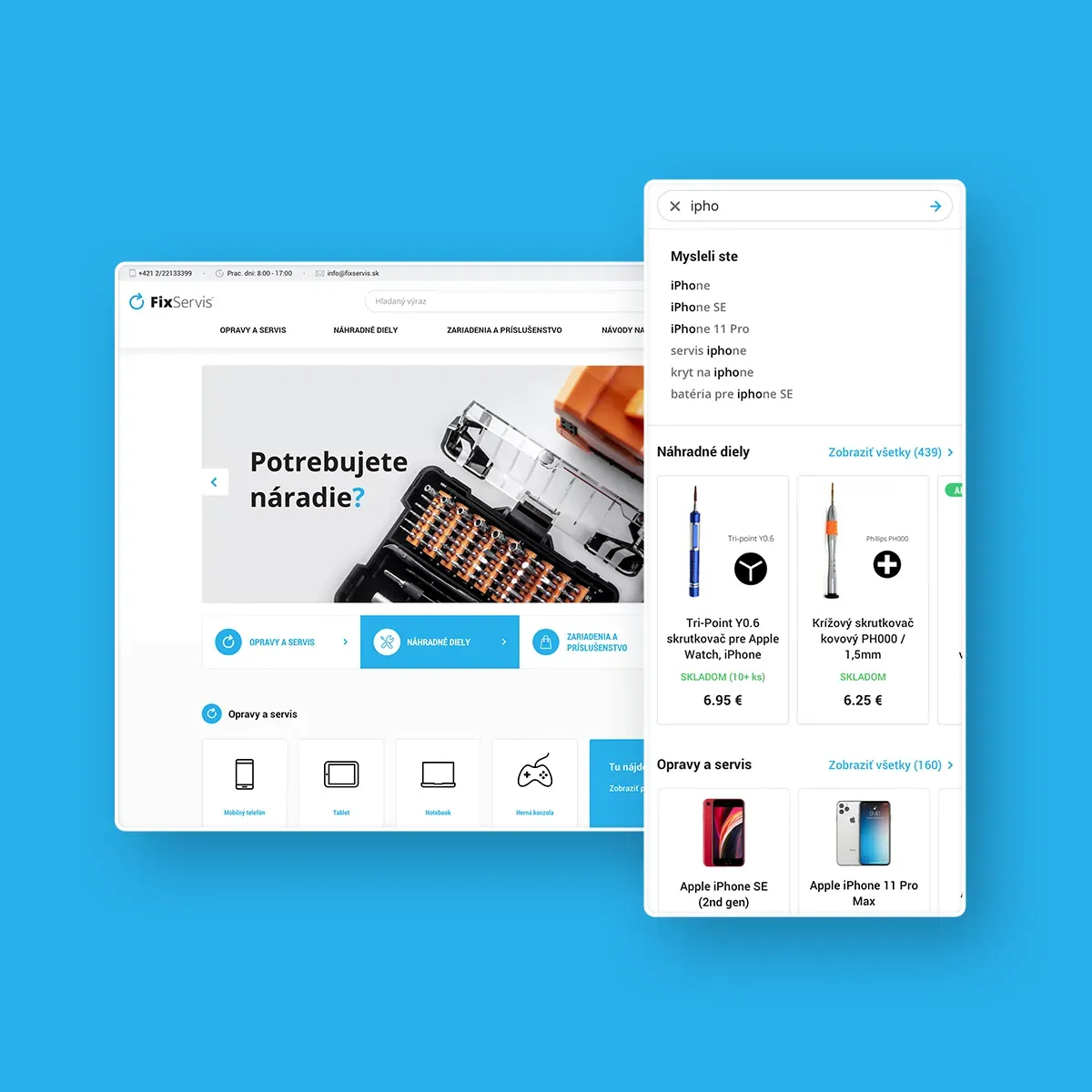
- fast search,
- optimised images,
- good hosting or infrastructure,
- well-configured caching,
- handling higher traffic,
- technical SEO.
A fast online store matters for customers and for search engines alike. A technically sound new online store has a better chance of good results in organic search.
Security must be part of development from the start
An online store works with sensitive data. It processes customers’ personal data, orders, addresses, payment information, trading terms and the company’s internal data. Security therefore cannot be an afterthought dealt with only after launch.
In e-commerce development, you need to think about secure sign-in, protecting the admin, managing permissions, securing the API, protection against attacks, regular updates and secure data processing.
The division of roles in the admin is also important. Marketing, customer support, the warehouse and company management each need different permissions. A good modern online store lets you set up access so that each user sees and edits only what they really need.
Security is also a question of trust. Customers need to be sure that their data is protected and that their purchase will go through reliably.
The admin determines how efficient your team is
In e-commerce development, a lot of attention often goes to what the customer sees. What the administrator sees is just as important. It is the admin that determines how quickly the team can work with products, orders, customers, content and promotions.
A good online store admin should be clear, fast and adapted to the company’s real processes. It should not force the team to take unnecessary steps or look for important information in several places.
A good admin can significantly reduce the amount of manual work. It helps the team process orders faster, edit products, check stock, create campaigns, manage customers and evaluate results.
A big advantage of a custom online store is that the admin can be designed around how the company really works. The team does not have to adapt to a ready-made system. The system adapts to the team.
SEO needs to be addressed during e-commerce development
SEO for an online store is about much more than copy and blog articles. A large part of SEO success depends on the technical design of the online store. If SEO is not addressed during development, fixing problems later can be difficult.
In e-commerce development, you need to think about URL structure, categories, filters, indexing, internal linking, speed, mobile layout, structured data, redirects and duplicate content.
Product and category pages are especially important. They must be technically sound, fast, easy to index and able to carry useful content. With filtering, you need to decide which filter combinations should be indexed and which could create unnecessary duplicates.
A well-built modern online store creates a solid foundation for long-term organic growth. If technical SEO is part of development, the marketing team is in a much better position to attract search traffic after launch.
Scalability: the online store must handle future growth
Scalability means that the online store can grow with the company. It can handle more products, more orders, more visitors, more languages, more countries and more internal users.
Not every online store has to be ready for extreme load from day one. What matters is that its technical foundation does not stand in the way of growth. If the system is designed correctly, it can be extended step by step as the company’s needs grow.
A scalable new online store should make it possible to:
- expand the product range,
- add new language versions,
- expand into other countries,
- connect more systems,
- process a higher number of orders,
- let several teams work in the admin,
- develop new sales channels,
- add a mobile app or a customer portal.