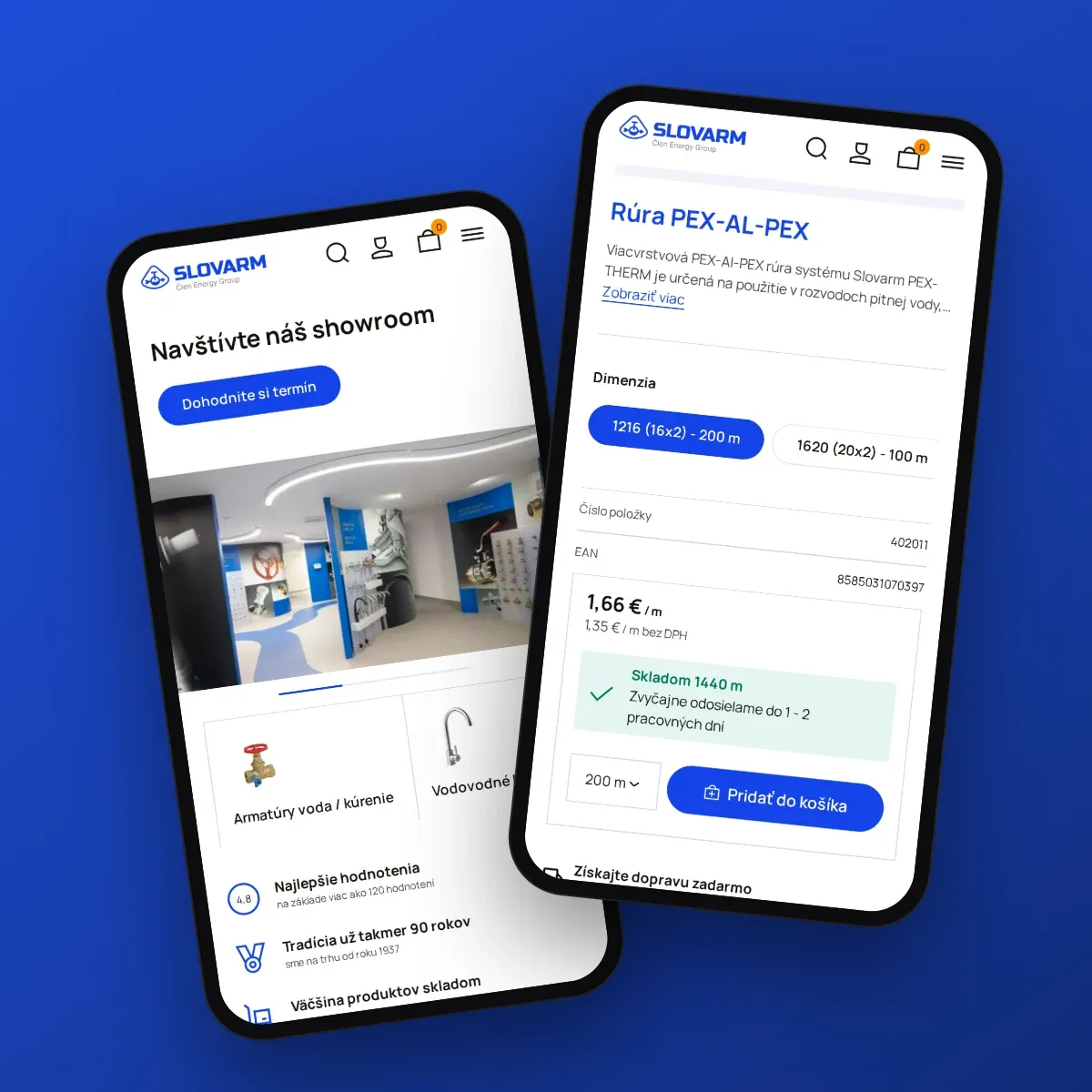
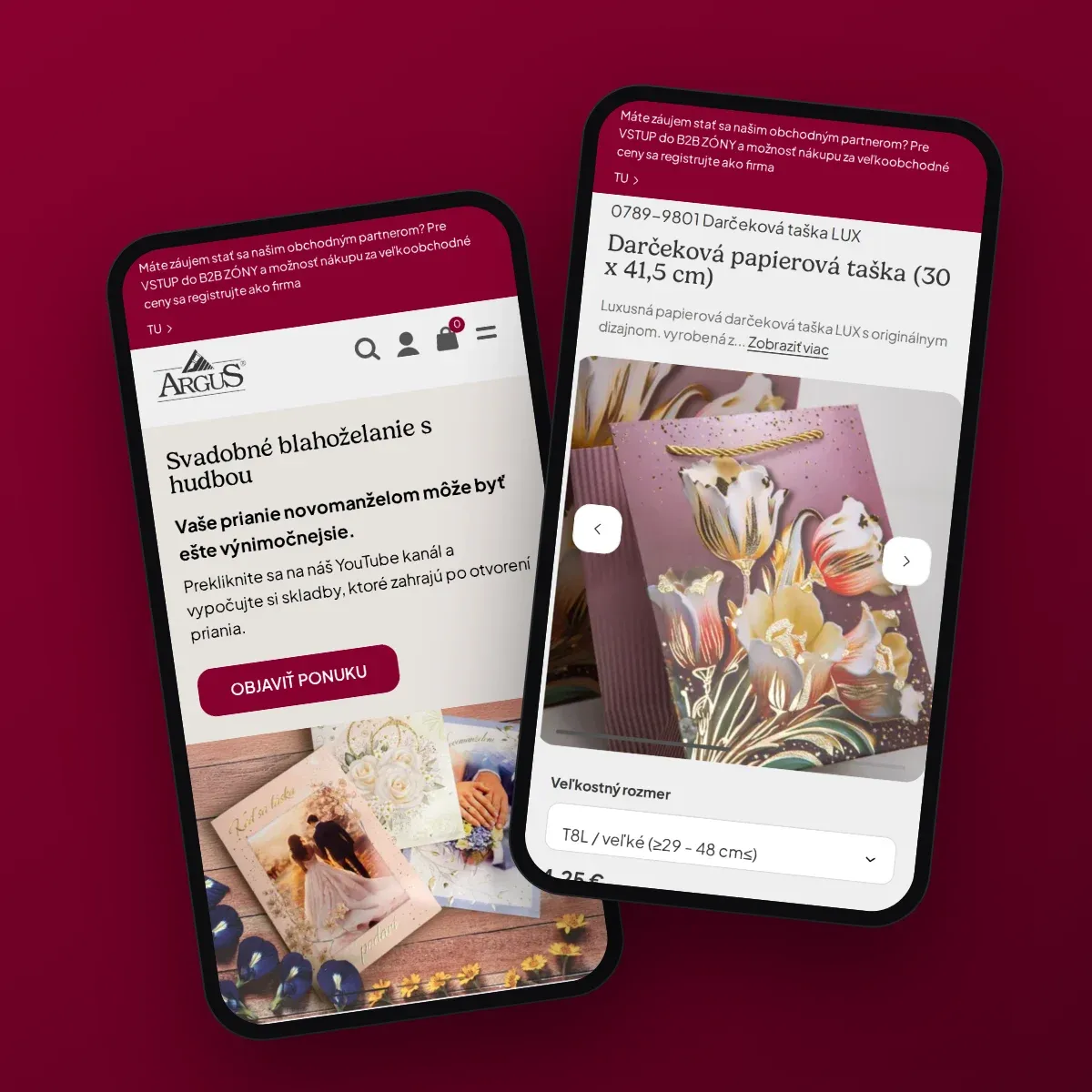
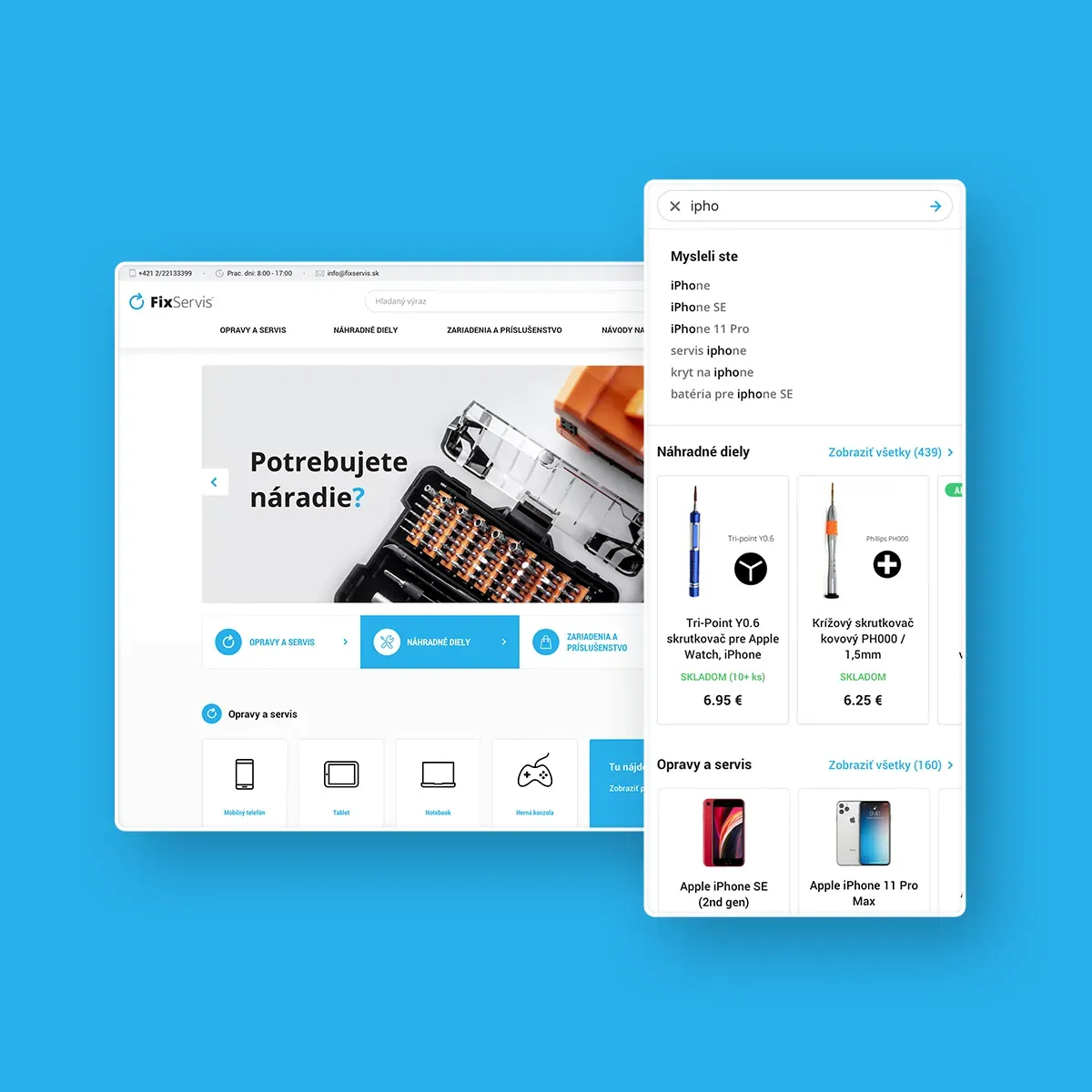
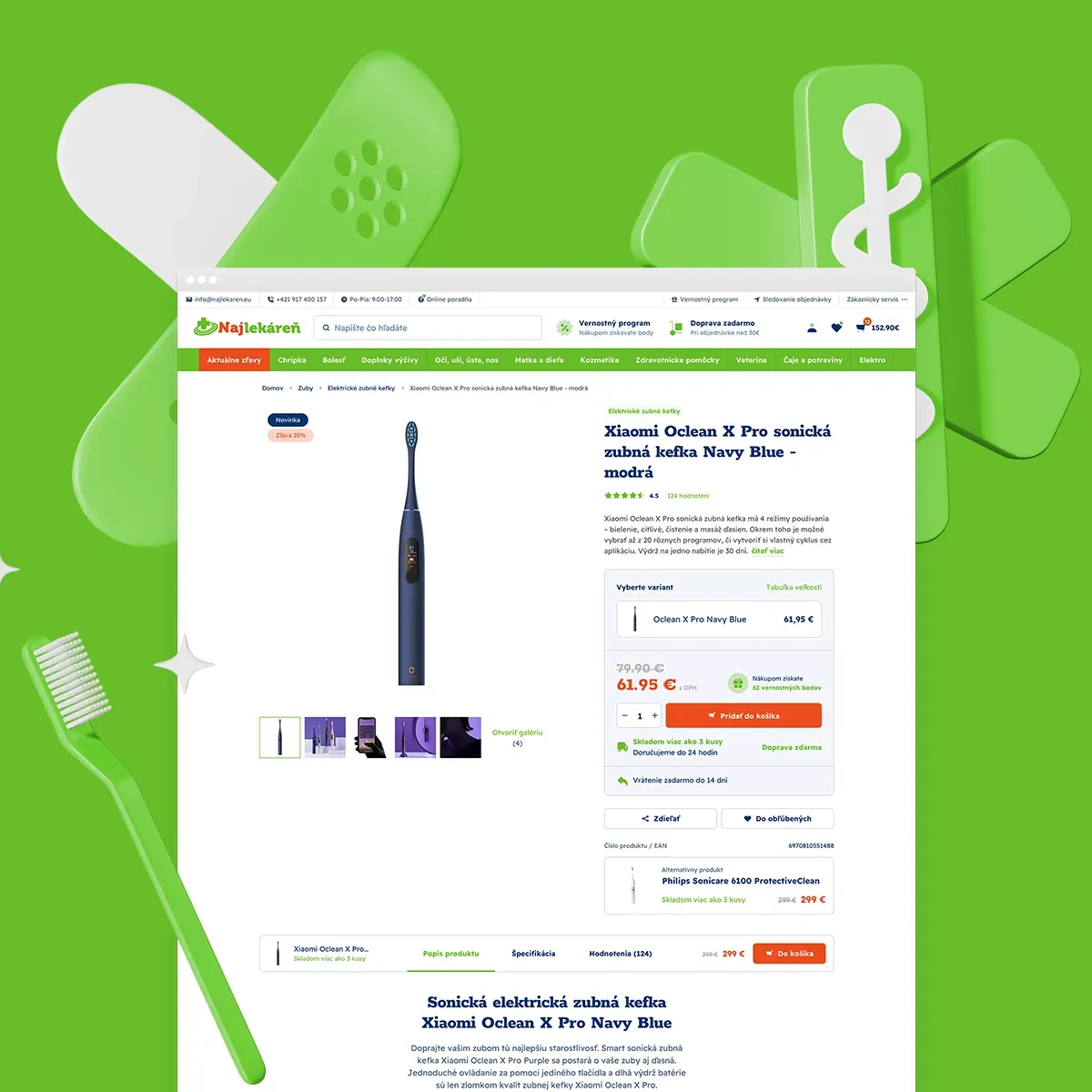

We have put together answers to the questions we hear most often about e-shop development, as well as our other services and custom software development.
Get in TouchSmartBase is a Slovak software house based in Bratislava that has been developing custom e-shops and e-commerce solutions since 2013. We mainly work with companies that have outgrown standard boxed e-commerce platforms and need high performance, their own functionality, integrations or room to keep growing.
A custom e-shop makes sense above all when your current platform starts holding you back. Typical reasons are complex processes, specific pricing, a large number of products, B2B sales, integrations with internal systems, expansion abroad or demands for advanced UX and automation.
We recommend starting with an analysis of where exactly the e-shop is slowing the business down, whether it is the technology, performance, UX, integrations or internal processes. SmartBase can analyze your current solution and propose how to optimize it, modernize it step by step or replace it with a new custom e-commerce solution.
A boxed e-shop works well where the company's requirements match what the platform can do. A custom e-shop adapts to the company's processes, not the company to the limits of an e-commerce platform. It lets you build your own features, complex integrations, B2B processes, automation and a user interface designed around your actual customers.
Yes. SmartBase focuses on scalable e-commerce solutions for companies that need to handle a growing catalogue, more orders, more users or new markets. We design the architecture so the e-shop can keep evolving together with the business.
Yes. Integrations are one of the core parts of SmartBase custom e-commerce solutions. We can connect an e-shop to ERP, warehouse systems, accounting, payment gateways, carriers, CRM and other internal or external systems through APIs and data integrations.
Yes. We automate, for example, order processing, product and stock synchronization, pricing, data transfer between systems, logistics processes and other repetitive tasks. The goal of automation is to cut manual work, errors and operating costs.
Yes. SmartBase builds custom B2B zones and ordering portals. They can include individual prices, price levels, product availability, customer accounts, order history, repeat orders or the specific business processes of individual B2B customers.
A B2B zone is an online customer area for a company's business partners. It lets them search for products, check prices and availability, place orders and manage their own account on their own. A well-designed B2B zone can greatly reduce the manual work of the sales team.
Yes. When we design e-shops, we combine UX/UI design, analytics, user behaviour and technical performance. The goal is not just a visually appealing e-shop, but a simpler customer journey from choosing a product to completing the order, one that supports your business results.
Yes. A UX and analytics audit can uncover the barriers that make buying harder for customers. We look at things like information architecture, navigation, search, product pages, the cart, checkout and other parts of the customer journey.
Yes. We can design the e-commerce architecture for multiple countries, languages, currencies and local business terms. The design also accounts for connecting local payment, logistics and other services, so further expansion does not mean rebuilding the whole system from scratch.
Yes. SmartBase develops AI-first solutions, AI agents and chatbots and can integrate AI into business and e-commerce processes. AI can help with finding information, customer support, working with internal knowledge or automating repetitive tasks.
Yes. SmartBase is a software house and, besides e-commerce, develops web applications, customer portals, internal systems and other custom software. A project can cover architecture design, UX/UI, development, integrations and data work.
Yes. In e-commerce we look at security as the security of the whole ecosystem, including the e-shop, the administration, ERP integrations, payment systems, external scripts and other connected services. SmartBase provides cybersecurity audits and services.
SmartBase is a good fit mainly for medium and large companies, growing e-shops, B2B companies and organizations with more complex digital processes whose requirements standard off-the-shelf solutions cannot fully cover.
A project usually starts with an analysis of business goals, customers, processes and existing systems. Then come architecture and UX/UI design, development, integrations, testing and deployment. After launch, the solution can continue with further development and optimization based on data and the company's needs.
A short description of what you need is enough. After an initial call we send an indicative scope and price. We prepare an exact quote once we have analyzed the features, integrations and data.
Typically two to six months, depending on scope and complexity. Simpler projects and Shopify e-shops are usually finished faster, and the data migration itself usually takes four to ten weeks. A complex system with a B2B zone, multiple integrations and custom processes needs a longer analysis, development and testing phase.
We first design and estimate every request and start working on it only after you approve it.
Yes. After launch we continue with support and further development. For larger scopes we reserve dedicated team capacity for you and a single project manager as your point of contact.
SmartBase brings e-commerce development, UX/UI, system integrations, automation, data solutions and AI together in one team. The result should be an e-commerce solution that does not just work technically, but supports the company's growth, efficiency and business results.
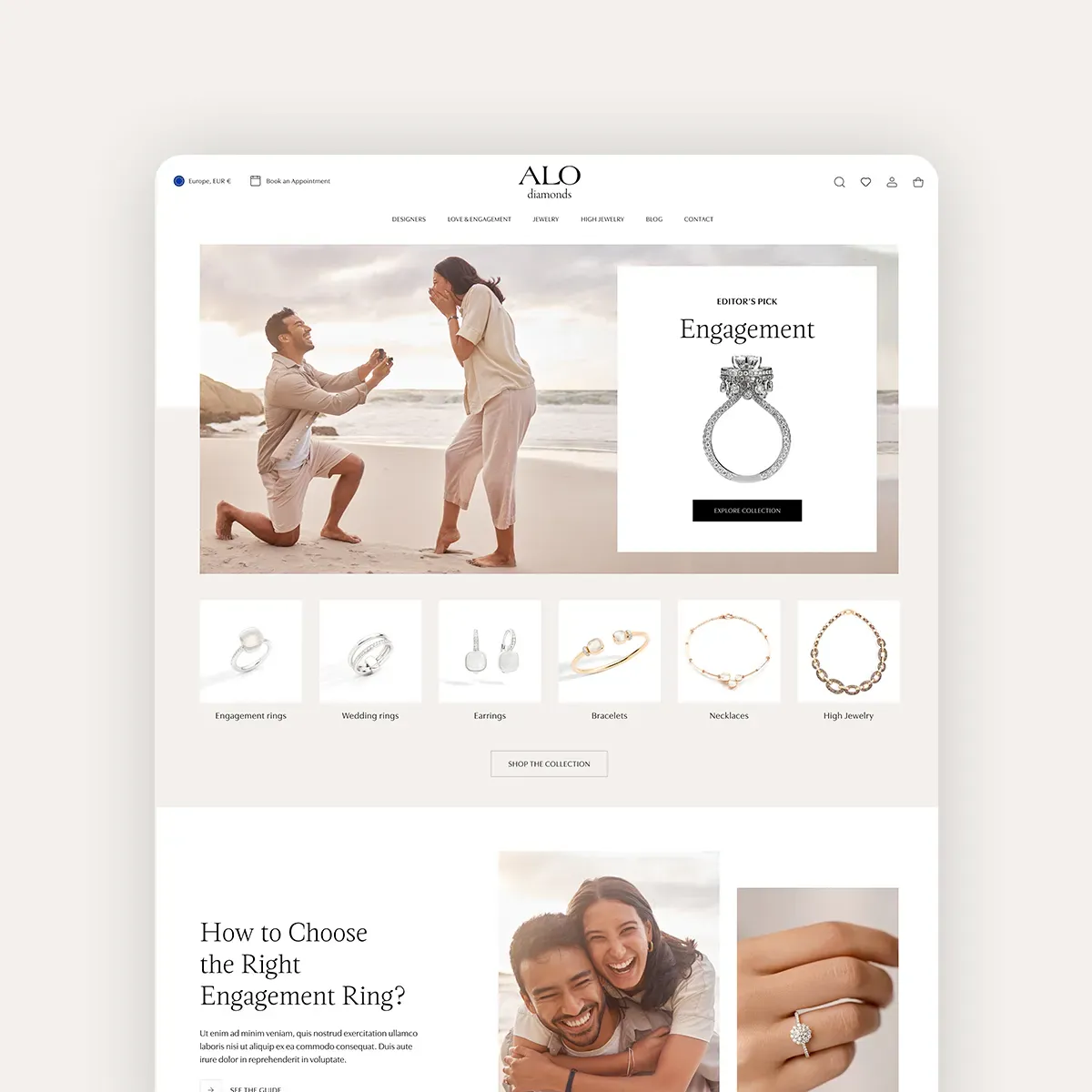
SmartBase has experience with complex e-commerce projects for medium and large companies, in both B2C and B2B. Our references include Kondela, FixShop, 4ka, ProSpánek, ALO diamonds, Argus, GREJT, Slovenka and Najlekáreň. The projects covered custom e-shop development, UX, integrations, data solutions and conversion optimization.
For a medium or large e-shop, a custom solution is often the right choice, especially if the company has complex processes, several systems, a large catalogue, high performance demands or plans for further growth. SmartBase develops e-commerce solutions with a focus on performance, UX, integrations and scalability.
If your e-shop is starting to slow down the company's growth, you do not automatically have to rebuild everything from scratch. It is best to start by analyzing performance, technical limits, UX, integrations and internal processes. SmartBase can propose a modernization, a migration or a new custom solution depending on where the real limits of your current system are.
For products with different units of measure, weights, lengths, packaging or made-to-measure sales, a standard e-shop is often too limiting. A better fit is a custom e-commerce solution that can work with its own logic for prices, quantities, rounding, stock and ordering.
Yes. A custom e-shop can take into account individual prices, volume discounts, customer groups, B2B price lists, time-limited promotions, margins, availability or data from the ERP. With complex pricing, a custom solution is often a better choice than a pile of add-ons on a standard platform.
A good fit is a B2B zone connected to the company's internal systems. After logging in, each customer can see their own prices, product range, availability, business terms, order history or individual products.
For a simple process, an off-the-shelf connector may be enough. But if the ERP holds complex logic for products, prices, warehouses, customers or orders, a custom API integration is the better choice. SmartBase has experience with complex integrations too, and our references include SAP and other ERP integrations.
Yes. A custom e-commerce solution can work with several warehouses, different availability rules, reservations, warehouse priorities or different availability for B2B and B2C customers.
Not always. First you need to find out whether the problem lies in the frontend, the database, integrations, hosting, the amount of data or the architecture itself. SmartBase can run an analysis and audit and then recommend optimization or a gradual technology change.
The number of products alone does not necessarily mean you need a custom solution. But when it comes with complex filtering, a large number of variants, external data sources, several warehouses, dynamic prices or multiple markets, a custom solution can be far more efficient.
Yes. For products with a large number of configurations, the UX design and the configurator logic matter most. On the 4ka project, for example, SmartBase worked with more than 250 configurations of devices and plans.
First you need to find out whether the limit is the platform itself or the way it was implemented. If the company needs specific processes, advanced B2B, complex integrations or its own business logic, the next step may be a migration to a custom solution. If an off-the-shelf platform suits you, we can also help you move to Shopify or extend it.
Yes. We build smaller projects on Shopify and larger ones on Shopify Plus or on our own platform, depending on what the project needs. The same team with the same integration know-how builds them all, so an e-shop can later move to a bigger solution without changing vendors.
Yes. We compare your processes, product range, integrations and growth plans with what each platform offers. Since we build on Shopify, Shopify Plus and our own platform, we recommend whatever makes sense for your project.
Yes. We transfer products, categories, content, customers and order history, set up payments, shipping and connections to your systems, and redirect the old URLs.
Yes. We customize the theme, add sections and connect apps, payment gateways and your own systems, as a one-off job or on an ongoing basis.
If the problem lies mainly in navigation, product pages or checkout, a UX redesign may help. But if the system cannot handle your processes, integrations, growth, performance or new features, the problem is probably technological and the architecture needs to be addressed too.
The biggest effect usually comes from combining UX analysis, work with data, site speed and optimization of product pages and checkout. For 4ka, SmartBase reports a 20% increase in conversion rate after optimization.
Processes can be automated by connecting the e-shop to the ERP, warehouse, carriers, invoicing or other internal systems. The goal is for data to flow automatically, so staff do not have to enter the same information into several systems.
A B2B portal can include individual prices, product range, stock availability, repeat orders, documents, invoices, business terms, order approval or an ERP connection. SmartBase offers the B2B zone as one of its standalone products.
Yes. A single platform can serve both end customers and business partners while using different pricing, product range, availability and buying process for each group.
It depends on the business model. For a larger e-commerce project, a central solution can be the better option. It shares products and data, but allows different languages, prices, currencies, product ranges and local integrations in each market.
The architecture should account for multiple languages, currencies, tax rules, local payments, carriers and different product ranges from the start. SmartBase also has experience with e-shops operating in several European markets, such as FixShop and ProSpánek.
Yes. Custom e-commerce can calculate the price by dimension, area, volume, weight or another parameter and then apply rules for minimum quantity, waste, packaging or shipping.
For made-to-order production, the e-shop needs to be connected to product configuration, price calculation, material availability and possibly the production system. In such cases a custom solution is usually far more flexible than a standard e-commerce platform.
Yes. A configurator can work with product compatibility, dependencies between parameters, dynamic pricing, stock and visualization. It is especially useful for technical products or products with a large number of variants.
The solution can synchronize stock, orders, customer accounts, reservations or in-store pickup. What matters is that all channels work with consistent data.
Yes. The checkout can be tailored to the customer type, the product, shipping, a B2B process or a specific business model. With a custom solution, the company is not limited by the platform's standard checkout.
SmartBase is a Slovak software house with offices in Bratislava and Prague, focused on e-commerce, B2B zones, UX, integrations and custom development. It is a good fit mainly for companies that have outgrown standard e-commerce solutions and need a more complex system.
Yes. We have offices in Bratislava and Prague and work with clients from Slovakia, the Czech Republic and other countries. We communicate in Slovak, Czech and English.
You can find our references on the website. If you would like to speak directly with one of our clients, we will put you in touch with their consent.
SmartBase® iObchodník
Go to pageiObchodník is a web app, so it runs on Android and iOS phones and tablets.
Yes. We prepare a demo where you can try the app.
To the ERP systems we have integrations with, such as Money S5, SAP Business One, Helios or K2. Others we connect on request.
SmartBase® Mobile Stockkeeper
Go to pageMobile Stockkeeper is a web app, so it runs on Android and iOS phones and tablets.
Yes. We present the app to you in a presentation.
To the ERP systems we have integrations with, such as Money S5, SAP Business One, Helios or K2. Others we connect on request.
Custom E-commerce Development
Go to pageWe start with workshops on your business and processes, product data, system integrations, design and marketing. They result in a project analysis, which we use to design, build, test and launch the e-shop. We tailor the deliverables to the scope: we always start with an analysis and a solution design, and larger projects continue with UX design and a custom visual design.
Your logo and brand guidelines, product data, access to your domain and marketing tools, your choice of carriers and payment gateway, and legal texts. We send you the full list of materials in advance.
Typically two to six months, depending on the scope of features, integrations and the amount of data.
The price varies and depends on the scope of the project, the required features, integrations, UX/UI, data migration and technical complexity. That is why in custom e-commerce it makes little sense to price a project only by the number of pages or products. A simple solution on a standard platform can cost from €6,000 to €15,000, while a custom solution starts at €30,000 to €50,000. SmartBase prepares a quote based on the specific requirements of your project.
Yes. We migrate products, categories, images and content. For customer accounts, we decide together whether to transfer them or let customers create new ones.
We set up B2B price lists and price levels, volume and partner discounts, time-limited promotions, discounts on bundles, categories or shipping, and a minimum order value.
Yes, from a single e-shop. Each country can have its own domain, prices, currency, shipping, payment methods and legal texts. The Kondela B2B portal, for example, takes orders from partners in five countries.
Your team, in an admin we set up around the way you work: managing products, orders, discounts and content. We automate whatever can be automated, for example carrier labels or invoicing.
After go-live comes a hypercare period, when we monitor the e-shop closely and fine-tune it quickly. Then we continue with support and further development. Our clients work with us long term and stay on the same solution as they grow.
With a custom e-shop you pay for hosting, a monthly service fee and the development of new features billed by the hour. We list the recurring costs separately in the offer, so you know them in advance.
Yes. We deploy the e-shop with a hosting provider or to your own infrastructure.
We plan the migration so you do not. We redirect old URLs to the new ones, move texts and metadata, and monitor indexing and search errors after launch.
Custom Development
Go to pageYes, we build both. A web app is enough when you want to start quickly and use it in the browser on any device. A native app for Android and iOS fits when you need scanning, notifications or offline work. We often start with a first version with the key features and develop it further.
Yes. In the administration you edit texts, images, products, pages and forms, and we set up access by the roles of your team.
ERP and system integrations
Go to pageWe connect to SAP S/4HANA and SAP Business One, Oracle ERP, Microsoft Dynamics 365 Business Central, Money S5, Helios, K2, Odoo, ANS and more. Other ERP systems we connect based on the integration options they offer.
Yes. We agree on the way to connect it with you and your ERP vendor, based on what the system offers.
In a workshop with you and your ERP vendor we agree which data flows in which direction and how often, separately for products, stock and prices. That becomes the integration design we sign off together.
Usually yes, mainly while the integration is designed. We coordinate with them, so you do not have to relay technical questions.
Usually yes. Products, prices and stock come from the ERP, while orders and customers are written back to it, with no manual retyping. We design what flows in which direction around your processes.
As fast as needed. Prices, availability and orders go through as soon as possible, large catalogue changes continuously. We set the pace by how often your data changes.
Yes. Our integrations routinely work with catalogues of tens of thousands of products and with individual prices for each customer.
No. Categories, attributes, images and texts can live in the ERP or in the store. We split them by where your team can manage them best.
A new customer from the store is matched with the existing company in the ERP, so no duplicate records with different data appear.
Yes. Price levels and individual prices from the ERP are shown to the signed-in customer, so they see the same as your sales rep.
We set the rules with you. The store can show the available quantity and the delivery date of the rest, offer an enquiry, or limit the order.
Yes. The order status and documents from the ERP can be available in the customer account.
Its sale in the store ends automatically. Empty categories and unused attributes can be cleaned up after the import.
Yes. The store can show availability by warehouse and by individual store, including click and collect.
No. We adapt the integration to your ERP set-up and to the established processes in your company.
The store stays and only its connection to the ERP is replaced. Customers will not notice the change.
Yes. Goods from several suppliers appear as one catalogue, and each order goes to the right supplier.
Yes. We often start with products and orders and add customer prices or other data in later stages.
No. We also connect to ERP systems running in your own infrastructure.
Yes. We use the same know-how on Shopify, Shopify Plus and our own platform, so a project can start on Shopify and grow on Shopify Plus or on our platform.
We design the integration so that a short ERP outage does not stop sales. Orders wait and reach the ERP once it is available again.
We do. We monitor the integrations we run and adjust them when your ERP is updated.
When you move to a new ERP version, we verify the integration and adjust it where needed, so the store keeps running without interruption.
Yes. Payment providers and instalments, carriers, comparison sites and marketplaces, marketing tools, company registers and fiscal cash registers.
It depends on the scope. A simple link of products and orders takes weeks. An integration where the ERP decides on price and availability live is part of a larger project. We give an estimate after a short analysis.